Description
Please Note:
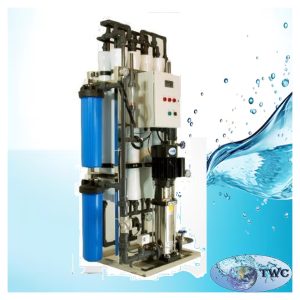
When you consider purchasing this 2000LPH RO system – 4 x 4080 membrane – 3 phase pump, you need to know the following information as it is very important.
This system requires a pretreatment setup for it to perform to its maximum capacity.
Below, the sketch shows
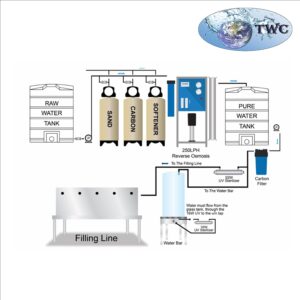
A basic pretreatment setup with the reverse osmosis system.
TWC’s 2000 l/ph Reverse Osmosis System is part of a family of reverse osmosis units specifically designed for operation with fresh and brackish feed waters having TDS values below 1,500ppm. As a result customers can access these Models with permeate output of 2000 liters/hr as shown in the specifications.
Benefits
- Specialized Micro-Computer Controller
- Fully Equipped and Customizable
- Super-Quiet Horizontal 3 phase Pump
- Low Energy Consumption
- High Flow Low-Energy Membrane
- Low Maintenance
- Compact Space Saving Design
The reverse osmosis systems have been widely used for commercial purposes such as treatment of wastewater, desalination, minerals reclamation, and purification of water. If you have been searching for the best and most efficient Industrial RO system, then you have landed at the right place. At TWC, we provide the best quality RO water units that can meet your needs, expectations, and budget.
As a matter of fact we provide the highest standard and compact commercial reverse osmosis system at an affordable pricing range. All our RO systems are highly durable and we guarantee that they can be last for many years with proper care and maintenance.
Standard Features
Pre-filtered water is fed to the RO system by means of the vertical centrifugal pump. The pump is controlled by the following parameters, namely:
- Product tank high level, indicated by a float level switch.
- Raw supply tank low level, indicated by a float level switch.
- Low pressure condition, indicated by the pressure switch.
- Timer unit contact.
The RO system generates two steams of water, a purified stream (permeate) is directed to the product tank, while the concentrated stream is directed to the drain. A ball valve on the concentrate line allows for manual flushing of the RO system.
Pressure indicators are fitted at strategic points to illustrate the systems operating pressure. Flow rate through the system can be monitored by the in-line rotameters on the permeate and concentrate lines.
En route to the product tank, permeate passes a conductivity probe, which reads conductivity of the product water.